
Table of Contents
Graphene Coating vs Ceramic Coating – A Complete Overview
Amongst all the comparisons between Graphene Coating and Ceramic Coating, one of the most looked-up ones is about car paint protection. Car owners are often curious about the durability, protection level, price, maintenance, and the lifetime of a coating.
No doubt, both of them give similar benefits such as car paint protection, gloss enhancement and easy maintenance, yet their performance, technology and long-term benefits vary.
What Is Ceramic Coating?
A ceramic coating is a liquid polymer applied to a car’s outer surface that bonds chemically with the manufacturer’s paint. After curing, it forms a protective layer that is hydrophobic and thus, water, dirt, and contaminants are repelled.
The long-lasting shine, UV protection apart from that very minor scratches are the reasons why ceramic coatings are widely used.
What Is Graphene Coating?
Graphene coating is a more advanced version of the paint protection technology and relatively new as well. The coating is enriched with graphene particles, which have extraordinary strength, heat-resistance and anti-static characteristics.
Graphene coatings not only create an armor-like layer that lasts longer than ceramic but also cause very little water spots and allow better heat dissipation.
Graphene Coating vs Ceramic Coating – Differences that Matter
Graphene coating and ceramic coating have different chemical structures and performance that’s why the main difference comes to that.
While ceramic coating’s major concern is gloss and hydrophobic protection, the graphene coating offers additional strengths, flexibility, and resistance to environmental strains.
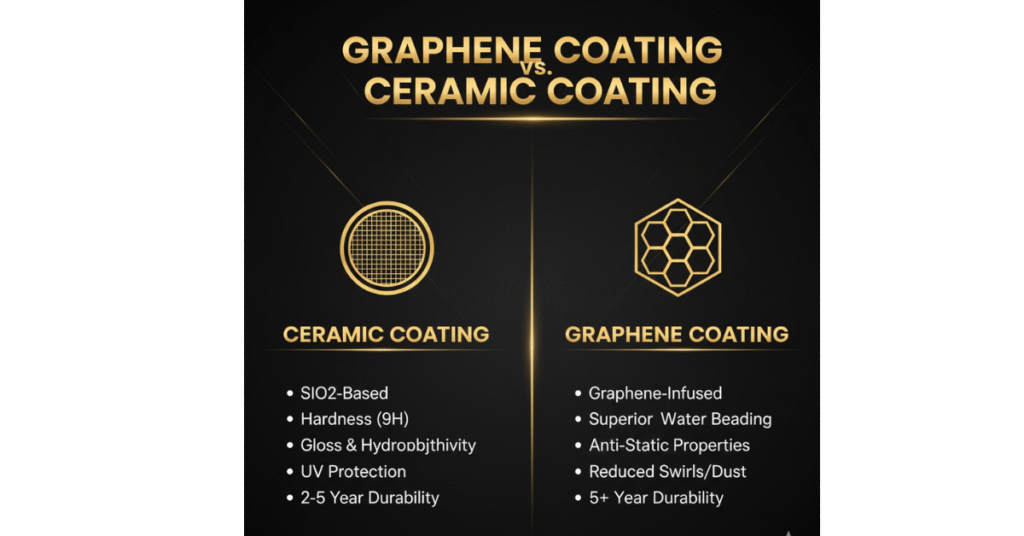
Durability: Graphene Coating vs Ceramic Coating
One of the most frequently asked questions is which coating is the most durable.
Ceramic coating is usually able to last for around 2 to 5 years depending on how well it is maintained
Graphene coating on the other hand has the potential to last for 5 to 7 years because of the strength of its molecular structure
In general, graphene coating is more durable and lasts longer.
Gloss & Shine Comparison
Both types of coatings improve the gloss of the paint but the resulting finish is a bit different:
Ceramic coating produces a deep, wet-look shine
Graphene coating presents a sleek, slick, mirror-like finish
Car lovers who like the maximum gloss often go for ceramic while the ones who want a cleaner look choose graphene.
Hydrophobic Properties & Water Behavior
Water behavior is yet another factor that receives a great deal of search traffic.
Ceramic coating does a great job of repelling water
Graphene coating, on the other hand, is less susceptible to spotting from water and has a more uniform drying
Graphene coating is advantageous in hot areas where water spots are a common problem.
Heat Resistance & UV Protection
Graphene coating stands out in terms of its heat resistance since it can effectively dissipate heat. As a result, paint damage from extreme temperatures is reduced.
Ceramic coating does offer some protection from UV rays as well, but it may be that it holds more heat than graphene.
Scratch & Chemical Resistance
Both coatings prevent your vehicle from being scratched but they have the following resistance to scratches and other substances:
Light swirl marks
Chemical stains from the chemicals in the car wash and drives
Bird droppings and tree sap
The stronger structure of the Graphene coating gives it slightly better resistance.
Maintenance & Cleaning
The question of which coating is easier to maintain is often asked by car owners.
Ceramic coating must be washed regularly.
Graphene coating has the benefit of attracting less dust because of its anti-static properties.
Graphene-coated vehicles are typically cleaner for longer periods of time.
Price Comparison: Graphene vs Ceramic Coating
Cost is a very important factor in the decision-making process:
Ceramic coating is less expensive
Graphene coating is more expensive due to the use of cutting-edge technology
However, over time, the total cost of ownership of graphene coating might be less because of its longevity.
Application Process – Are They the Same?
The processes of applying the coatings are similar in that they all need to:
Proper washing and decontamination
Paint correction (recommended)
Careful application and curing
The application of graphene coating might need more accuracy, particularly when dealing with professional-grade products.
Graphene Coating vs. Ceramic Coating – Which One Should You Choose?
If you want:
- Strong gloss enhancement
- Proven technology
- More affordable protection
- Choose ceramic coating.
In contrast, if you prefer:
- Longer durability
- Better heat and water spot resistance
- Premium paint protection
Choose graphene coating.
Your decision rests on the factors of budget, climate, and usage.
Pros and Cons of Ceramic Coating
Pros:
- Brilliant gloss
- Cost-effective
- Easily accessible
Cons:
- Not as long-lasting as graphene
- May get water spots
FAQs:
1. Is coating with graphene superior to coating with ceramic?
Certainly, the coating of graphene imparts more longevity as well as heat resistance while on the other side the coating of ceramics makes it easier on the pocket.
2. Which of the coatings has a longer life span, that of graphene or that of ceramics?
Basically, the coating of graphene has a longer life than that of ceramics.
3. Is the coating of graphene an extravagant notion?
Most of the car owners would say that it has been a good investment after having the car protected for a long time with less maintenance.
4. Is the coatin of graphene able to stop scratches from happening?
No coating can be scratch-proof, but the coating of graphene will resist light scratches better.
5. Is it possible to put the coating of graphene on top of the coating of ceramics?
This is conditioned not only by the product but also by the surface; it is better to have a professional gauge the situation.
6. Which of the two coatings would be more suitable in a hot weather situation?
The coating of graphene is more suitable for hot weather since it can endure high temperatures more effectively.